Technological dependence and systemic collapse
The SilenceTechnological dependence and systemic collapse is the novel’s depiction of ordinary life losing the systems that make it function: screens go blank, phones and computers fail, lights disappear, and transport and power become uncertain. The breakdown is more than a technical inconvenience. It exposes how closely communication, safety, movement, work, and even the interpretation of events depend on networks that had seemed reliable, while leaving the characters unable to tell whether the failure is temporary, deliberate, or part of a larger transformation.
Scope and Uncertainty
The collapse first becomes tangible through a screen that changes from an image into abstract, pulsing patterns and then goes blank. There is no sound, despite repeated attempts to raise the volume. Max Stenner switches the screen off and on, but it stays blank; he and Diane Lucas find their phones dead, the landline without a dial tone, and the laptop lifeless. A computer in another room remains gray when Diane tries it. The sequence moves through distinct devices rather than presenting a single broken appliance: the household’s usual channels for seeing, hearing, and contacting others fail together. Max’s calm question about his bet gives the failure an almost absurd domestic measure. A concern premised on an operating digital world persists for a moment after the world that supported it has vanished.
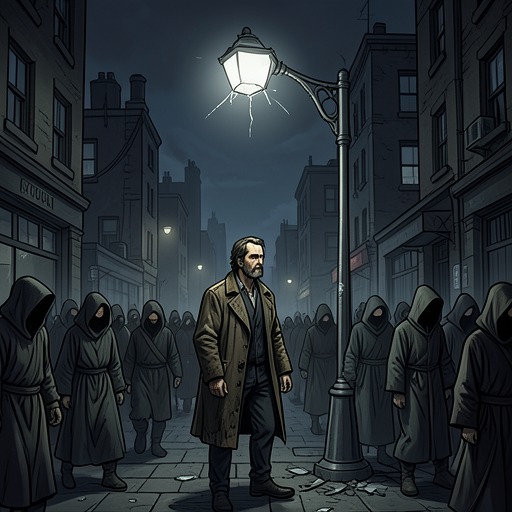
The characters encounter evidence of a broad breakdown without acquiring a clear explanation. At a clinic, an unnamed woman points to its blank wall of devices and says that whatever is happening has crushed technology. She wonders what has become of secure devices, encryption, social media, and the presumed protections of the data sphere. Her questions are not answers: the novel offers no confirmed account of who or what caused the wider failure. When the clinic lights blink, dim, and go out, the silence and waiting make the uncertainty physical. The darkness could mark a radical and permanent change, but the people there do not yet know what it means.
Everyday Systems Made Visible
The clinic woman’s concerns map the breakdown onto the routines that infrastructure normally conceals. She worries about the cold, the loss of light and heat, and the practical possibility of getting home if subways, buses, taxis, and her building’s elevator no longer work. She lives above a restaurant called Truth and Beauty and loves her cubicle, but neither attachment can substitute for functioning transport or power. Her fear is not abstractly about technology; it is about being stranded, losing shelter, and dying in a workplace as its supporting systems fail.
Other scenes extend the same disruption beyond communications. Jim Kripps and Tessa Berens have come from a plane that made a crash landing, and Jim needs treatment for a wound. At the clinic, a young man applies medication and bandages it; the overhead lights later fail, making the care environment itself vulnerable to the wider outage. Afterward, the wind is fierce, and the only person they see is a hobbling man pushing a battered cart that may hold everything he owns. At a major intersection, the digital traffic warden stands still, one arm raised. The stalled signal and the man’s cart make different kinds of vulnerability visible: an automated system no longer directs movement, while a person continues through the street with whatever possessions he can push. Jim and Tessa have no apparent task beyond walking on.
From Network Failure to War
The novel places technical disruption within an expanding account of conflict. By the second part, launch codes are described as manipulated remotely by unknown groups or agencies, and nuclear weapons worldwide have become dysfunctional: missiles do not cross oceans and bombs are not dropped from supersonic aircraft. That does not mean the war has ended. Cyberattacks, digital intrusions, biological aggression, pathogens, death, disability, starvation, and plague accumulate as its terms. The contrast is consequential: the familiar spectacle of nuclear attack is absent, while violence continues through other channels and through the breakdown of systems on which civilian life depends.
Power grids collapse as well, and the narration links this material failure with personal perception sinking into what it calls quantum dominance. The language does not supply a technical explanation; it places the collapse of shared infrastructure beside a less stable experience of reality. Martin Dekker names the conflict World War III, but the novel’s questions about empty screens and global silence remain open. Speculation about people with phones implanted in their bodies, subcutaneous calls, or a bodily warning code is presented as a question, not as a discovered technology. The distinction matters: the characters can imagine mechanisms of communication even as they lack evidence that such mechanisms exist.
Memory, Practical Needs, and Meaning
Tessa Berens places the present failure against a long record of warning signs: storms, wildfires, evacuations, typhoons, tornadoes, drought, foul air, landslides, tsunamis, disappearing rivers, collapsing buildings, and skies obscured by pollution. She also recalls viruses, plague, airport crowds, face masks, and emptied city streets. Her catalogue does not prove that any one disaster caused the current collapse. Instead, it frames the shutdown as the latest in a succession of disturbances that people had experienced repeatedly, sometimes elsewhere, and perhaps learned to treat as separate episodes.
Her questions widen from the blank screen in an apartment to the surrounding situation: who is doing this, whether minds have been digitally remastered, and whether the people present are part of an experiment beyond their understanding. The reach of those questions exceeds what anyone can verify. In that gap, Tessa also challenges the group’s impulse to keep speaking philosophically. She considers whether food, shelter, friends, and basic bodily needs should take priority over interpretation, naming touch, feeling, eating, and chewing as practical concerns. The thought does not solve the crisis; it makes clear what the crisis threatens at its simplest level.
The concept’s force comes from this movement between a failed device and a failed environment. A blank display, a dead phone, a dark clinic, an immobile elevator, and a silent traffic signal are not interchangeable symptoms, but they expose interdependent systems as they cease to serve people. The resulting silence is both material and interpretive: screens no longer show what is happening, and the characters cannot agree on an explanation that the evidence confirms. The novel makes dependence legible through interruption, while withholding the certainty that would turn interruption into a fully understood event.